Chip Storm Sweeps US Stocks: Market Concerns and Future Direction Behind AI Capex Frenzy
Summary
On Monday, the US stock market experienced a sudden "chip storm." While the major indices appeared calm, the Philadelphia Semiconductor Index once plunged nearly 5% intraday, closing down 2.23%. Nvidia, SanDisk, SK Hynix, AMD and other star chip stocks fell collectively, and lithography leader ASML was also hit. Goldman Sachs trader John Flood pointed out that multiple events intertwined — the Fed meeting, heavy tech earnings, hedge fund exposure contraction, and deep market doubts about AI capex sustainability — collectively triggered the turmoil. This article will start from the surface of market anomalies, deeply analyze the underlying structural factors, and explore the future direction of US stocks.
Keywords: Chip stocks; AI capex; CDS; Federal Reserve; Market volatility
I. Introduction: Structural Anxiety Behind the "Numbers"
On the last Monday of July 2026, US stock investors were caught off guard by a sudden yet familiar "chip storm." The Dow Jones index fluctuated slightly, the S&P 500 was calm, but the Philadelphia Semiconductor Index once fell nearly 5% intraday, closing down 2.23%. This apparent index "calm" masked the intense volatility within the sector — Nvidia closed down 4.99%, SanDisk plunged 11.02%, SK Hynix fell 7.47%, AMD fell 5.17%, and even ASML, the absolute leader in lithography, dropped 5.8%. The market seemed to be reminding all participants in an extreme way: the valuation narrative of the chip sector is facing an unprecedented interrogation.
Goldman Sachs trader John Flood wrote in the day's market flash that his desk received a large number of client inquiries about the latest market conditions. The senior partner simplified the core factors driving the market that day into a complex multi-event combination — the Fed meeting, tech giant earnings, geopolitical noise, and most fundamentally: deep market suspicion that the AI industry's "circular financing frenzy" may have reached its peak.
II. Resonance of Multiple Events: Why Did "Chips" Become the Storm Center?
2.1 The Fed's "Real-Time" Test and Policy Fog
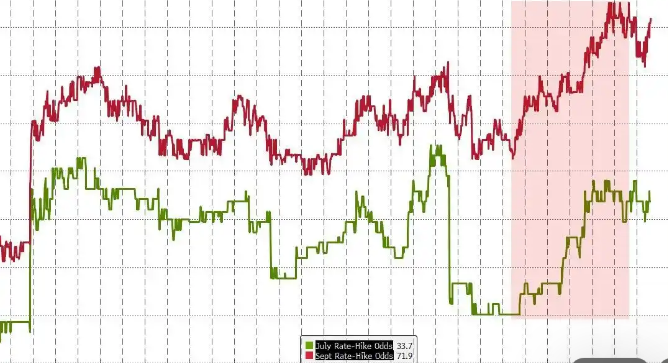
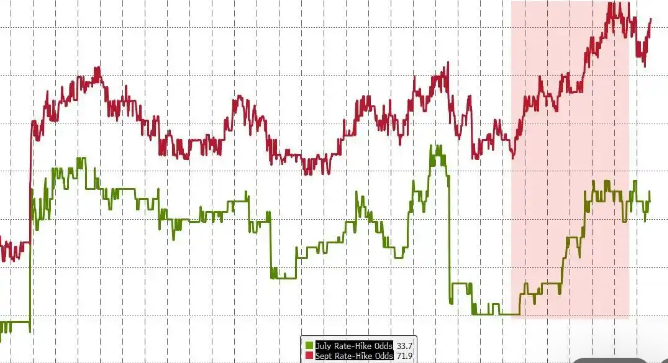
On Wednesday, a "real-time" Fed meeting is coming — not a routine meeting with a preset policy path, but a game with a 35% probability of a rate hike. With inflation data fluctuating and the job market still tight, market concerns about a possible surprise rate hike are growing. Uncertainty in rate expectations directly suppresses the valuation space of high-risk assets, and chip stocks, as the most aggressive valuation expansion sector in this AI bull market, are the first to bear the brunt.
More worrisome, Meta and Microsoft report earnings after Wednesday's close, followed by Apple and Amazon on Thursday. The performance of these tech giants not only affects their own stock prices but also directly determines the "fundamentals" of the AI capex story — each company's future spending guidance will be seen as a "thermometer" for the health of the AI supply chain. Amid such dense key events, the market generally lacks the will to take the initiative.
2.2 Hedge Fund "Retreat" and Long-Only "Wait-and-See"
Observations from the Goldman Sachs desk show that hedge funds are "sporadically cutting single-stock exposure risk" — in Flood's words, "selling again." This means trend-following funds that previously bet on rising chip stocks are actively shrinking. In contrast, long-only institutions (L/Os) are standing pat, waiting to see. This pattern of "one side retreating, the other waiting" leaves the market without effective buying support, and once negative catalysts appear, panic selling easily occurs.
III. Turning Point Signals for AI Capex "Frenzy"?
3.1 Nvidia "Financing Guarantee" Rumors: Peak of AI Circular Financing?
A major rumor recently circulated: it is reported that Nvidia is negotiating to provide financial guarantees of up to $250 billion for OpenAI's planned data center project in Ohio, and may further provide financing for purchasing chips needed for the facility, potentially an additional $350 billion. This means that if the plan materializes, Nvidia will not only be a chip supplier but also deeply embed itself as a financier in the financial chain of AI infrastructure.
However, this rumor did not receive a "positive" response from traders. On the contrary, many industry insiders believe this may mark the peak of the AI circular financing frenzy. When a chip manufacturer needs to provide such large-scale financial guarantees for downstream projects, it means that "external capital" in the supply chain can no longer independently support such infrastructure scale, or the market has begun to question the sustainability of the existing business model.
3.2 CDS Surge: The Most Direct Reflection of Credit Risk
The market's concern about AI capex frenzy is most intuitively reflected in credit default swap (CDS) prices. According to ICE Data Services data, Nvidia's five-year CDS once rose about 14 basis points on Monday, reaching an annual rate of about 82 basis points at its peak — the largest single-day intraday increase since the contract began active trading last November. Meanwhile, CDS prices for Oracle, SpaceX, Alphabet, Amazon, Meta, Broadcom and other tech giants have all risen to historic highs in recent days.
The essence of CDS is the cost of debt default insurance. Its surge indicates that the market believes the credit risk of these companies is significantly increasing. For Nvidia, despite its strong cash reserves, the market is beginning to worry that its huge capital commitments in AI infrastructure — whether direct spending or financial guarantees — may gradually erode the safety of its balance sheet. For cloud giants like Amazon, Google, and Meta, the "arms race" in data centers and chip procurement is swallowing huge cash flows, while the corresponding return cycle is full of uncertainty.
3.3 The Paradox of "Better-than-Expected Earnings but Sell-off"
Flood specifically points out that current semiconductor earnings reports generally show a strange phenomenon of "better-than-expected results but selling on rallies." Ahead of another round of heavy earnings season, this divergence clearly exacerbates market nervousness. From a fundamental perspective, revenue and profit data for Nvidia, AMD and other companies remain strong, but the market seems no longer satisfied with "current performance" and is beginning to proactively evaluate the "cost price" behind this growth — that is, how much capital expenditure is needed to support every dollar of AI revenue? When the growth rate of capex begins to exceed revenue growth, the market's valuation logic undergoes a fundamental shift.
IV. External Variables and Geopolitical Noise
4.1 Chinese Memory Chip Company's "Catfish Effect"
On the news front, the explosive debut of Chinese memory chip company CXMT on its first trading day brought a new variable to the global memory chip sector. The strong listing of a Chinese company not only diverted some global funds but also made the market re-examine the geopolitical competition landscape in the memory chip field. Lithography leader ASML declined on Monday due to industry rumors, also reflecting investor concerns about technology control upgrades and supply chain risks.
4.2 Geopolitics: Iran Issue and Trump's "Ultimatum"
On the geopolitical front, headlines about Iran remain "annoying and confusing." Former President Trump clearly stated: "Either negotiations move fast or they're off." Such tough rhetoric, combined with ongoing tensions in the Middle East, further increases volatility in risk assets. For chip stocks, geopolitical disturbances not only affect supply chain expectations but may also be transmitted to valuation models through channels such as energy prices and the dollar exchange rate.
V. The "Double Whammy" of the Rates Storm
5.1 Real Yields Surge: Historical Experience Signals Risk
Flood's biggest concern is that rate volatility will further increase upward pressure on stock volatility. US Treasury yields have surged sharply in the past week — the 10-year real yield has risen to its highest level since 2023, while the 30-year real yield is approaching 3%. During the global financial crisis, this high level was only breached in certain brief violent fluctuations. Rising real yields directly weaken the appeal of stocks relative to bonds, especially for high-valuation growth stocks that rely on future cash flow discounting.
5.2 The "Death Threshold" of Two Standard Deviations
Historical experience shows that when interest rates rise more than two standard deviations over a specific period, US stocks usually struggle. According to Flood's calculations, the current threshold of two standard deviations corresponds to a monthly rise of about 50 basis points in the 10-year yield. This means that if the nominal 10-year Treasury yield spikes to around 5% in the short term, or the 10-year real yield rises to around 2.7%, the US stock market will face more severe downward pressure. Given that current real yields are already at historical highs, they are just a step away from this "death threshold."
VI. Future Outlook: How Will Risk Appetite Reshape?
6.1 Short-Term Volatility Continues, but Major Indices May Stabilize?
Flood believes that individual stock volatility in US stocks may remain high in the near term. However, as companies continue to deliver results, major indices may still stabilize and rise. His logic: although hedge funds are retreating, long-only institutions are not actively selling, just temporarily waiting. Once the earnings season provides clear earnings outlook guidance, capital may re-enter. In addition, although the market has begun to price in a rate hike, and even fully absorbed the possibility of a September hike, Wednesday's Fed meeting may not actually raise rates — which itself could become a turning point of "bad news out of the way."
6.2 Significantly Reduced Crowding: Opportunity After Deleveraging?
Goldman Sachs prime brokerage data shows that hedge fund risk exposure and leverage have been significantly reduced, with crowding notably lower. This means that the "overtrading" and "herd bets" in the market are dissipating. From a contrarian perspective, when most trend traders are forced out, real value investors may find more attractive entry points with better safety margins.
6.3 Rare Gap Between S&P 500 Components and Index Implied Volatility
Notably, Flood observed a rare large gap between S&P 500 component stocks and index implied volatility. This indicates that while volatility pricing at the index level is still within a controllable range, risk expectations at the individual stock level are rapidly diverging. This structural divergence often signals that the market is undergoing a complete reshaping of "stock selection logic" — the era of simply betting on the index may be temporarily over, and selecting quality targets while controlling credit risk will become the main theme for the near future.
VII. Conclusion: The Necessary Path from "Frenzy" to "Rationality"
This "chip storm" is no accident; it is the inevitable product of the AI industry transitioning from the "storytelling" stage to the "number-crunching" stage. When Nvidia's CDS surged 14 basis points in a single day, when tech giants' CDS collectively hit record highs, and when chip companies have to rely on financial guarantees to push downstream projects forward, the market is sending the clearest warning through price signals: the "infinite game" of AI capex may be near its end.
For investors, the most important thing right now is to stay clear-headed — not to be fooled by the surface of "better-than-expected results," but to look through the data and understand the return logic behind every dollar of capital expenditure. The Fed's rate decision, earnings season guidance, and geopolitical variables will all become touchstones for testing the true resilience of the AI supply chain. And that old Wall Street saying may still apply: When the tide goes out, you discover who's been swimming naked.