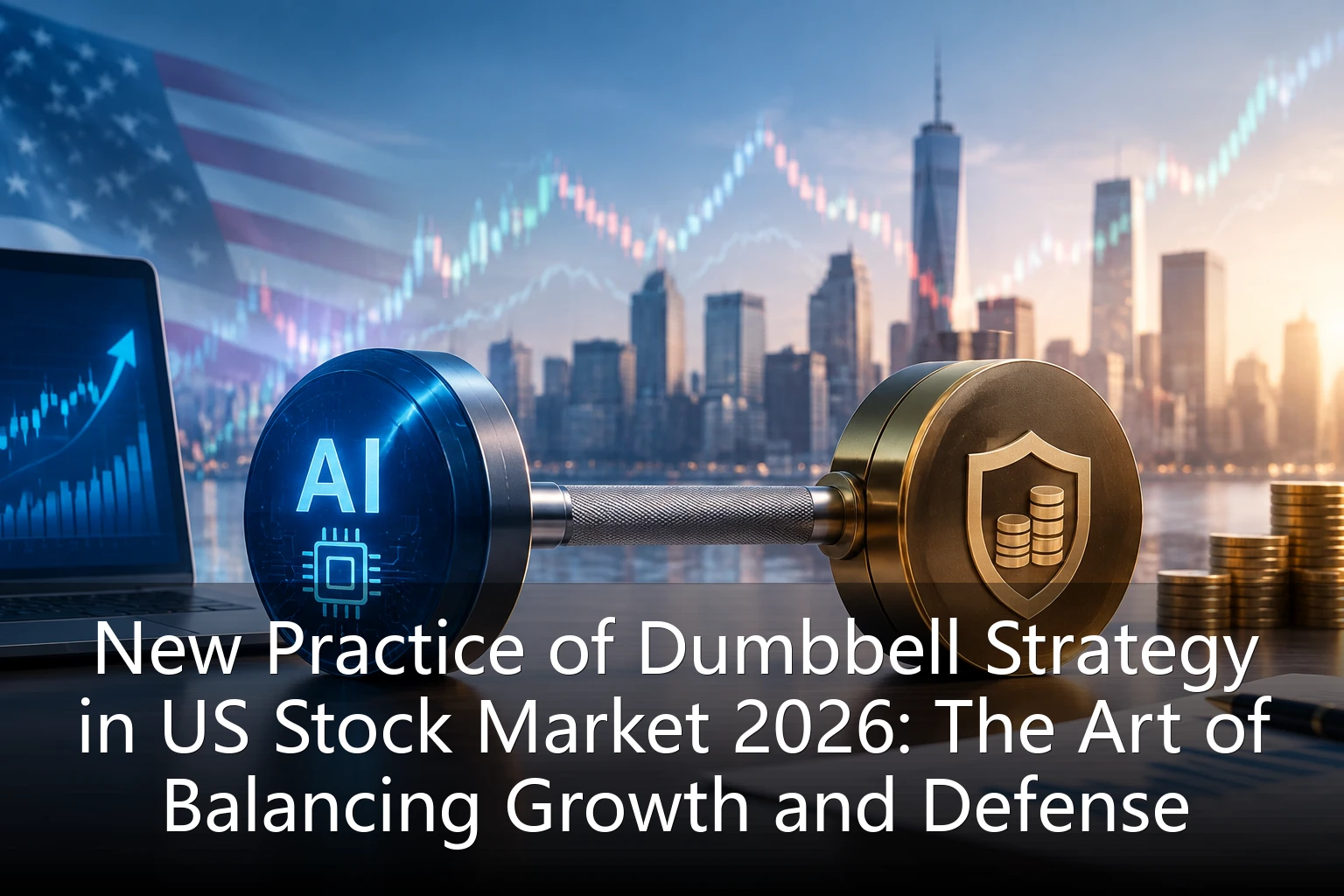
Dumbbell Strategy: The Winning Formula for US Stock Market in 2026
\nIn the uncertain market environment of 2026, investors are facing unprecedented challenges. Multiple factors intertwined, including Federal Reserve policy shifts, AI technology revolution, geopolitical tensions, and global economic rebalancing, have significantly increased volatility in the US stock market. Faced with such market conditions, traditional asset allocation methods can no longer meet investors' dual needs for steady growth and risk control. Against this backdrop, the dumbbell strategy, as an investment approach balancing growth and defense, has once again become a focus for professional investors.
\n\nCore Principles and Evolution of the Dumbbell Strategy
\nThe dumbbell strategy is an asset allocation method that focuses on allocating investment portfolios to two extremes: one end is high-risk, high-return growth assets, while the other end is low-risk, stable-return defensive assets, with relatively less allocation in the middle. This strategy gets its name from the shape of a dumbbell, heavy at both ends and light in the middle.
\n\nThis strategy can be traced back to the 1990s, proposed by famous investment strategists, initially mainly used to deal with extreme market volatility. However, with changes in the market environment, the dumbbell strategy has continuously evolved. In the US stock market of 2026, the dumbbell strategy has evolved from a simple "growth + defense" binary allocation to a more refined multi-dimensional balance system, not only including the balance between stocks and bonds, but also covering multiple dimensions such as industry, style, and geography.
\n\nNew Interpretation of Dumbbell Strategy in 2026 Market Environment
\nEntering 2026, the US stock market shows several significant characteristics: first, AI-related stocks have undergone valuation restructuring, with some leading stocks returning from excessive optimism at the beginning of the year to rational levels, but long-term growth prospects remain clear; second, after the rapid interest rate cuts at the beginning of the year, the Federal Reserve has entered an observation period, increasing uncertainty in the interest rate environment; third, geopolitical risks continue to exist, especially intensifying competition in the technology sector; finally, digital transformation of traditional industries is accelerating, with continuous emergence of value reassessment opportunities.
\n\nIn such a market environment, the value of the dumbbell strategy becomes increasingly prominent. On one hand, investors need to capture growth opportunities in emerging fields such as AI and clean energy; on the other hand, they also need to hedge market volatility risks through defensive assets. The dumbbell strategy can meet this demand, helping investors achieve balance in an uncertain market environment.
\n\nImplementation Methods and Asset Selection for Dumbbell Strategy
\nIn the US stock market of 2026, implementing the dumbbell strategy requires consideration from the following dimensions:
\n\n- \n
- Growth End Asset Allocation: Including high-growth potential stocks such as AI hardware and software leaders, biotechnology innovation companies, and clean energy technology companies. These companies usually have strong R&D capabilities and innovation advantages, enabling them to take a leading position in technological changes. \n
- Defense End Asset Allocation: Including leaders in defensive industries such as consumer staples, utilities, and healthcare, as well as high-quality bonds and dividend growth stocks. These assets perform relatively stably during economic downturns or market volatility. \n
- Balanced End Asset Allocation: Including undervalued traditional industry leaders and companies with stable cash flows. These assets can provide additional returns when market styles shift. \n
Specifically, a typical dumbbell strategy portfolio might include: 40% growth technology stocks (such as AI, cloud computing, semiconductors, etc.), 30% defensive assets (such as consumer staples, healthcare, utilities, etc.), and 30% value assets (such as financial, energy, industrial, etc.). Of course, this ratio can be dynamically adjusted according to investors' risk preferences and market conditions.
\n\nPerformance of Dumbbell Strategy in Different Market Cycles
\nHistorical data shows that the dumbbell strategy performs well in different market cycles. During market uptrends, growth assets can provide excess returns; during market downturns, defensive assets can provide a buffer; during market fluctuations or style rotations, balanced assets can capture rotation opportunities.
\n\nTaking 2026 as an example, AI-related stocks experienced significant fluctuations in the first half of the year, while dumbbell strategy investors effectively hedged market volatility risks by simultaneously allocating defensive assets. Meanwhile, as economic data improved in the second half, value stocks outperformed growth stocks, and dumbbell strategy investors successfully captured this style rotation opportunity through balanced end asset allocation.
\n\nRisk Management and Optimization of Dumbbell Strategy
\nAlthough the dumbbell strategy has many advantages, risk management still needs attention during implementation. First, investors need to regularly evaluate the performance of assets at both ends and adjust the proportion in a timely manner according to market changes. Second, avoid over-concentration in a single asset category, even at both ends of the dumbbell, appropriate diversification should be maintained. Finally, establish strict stop-loss mechanisms to prevent significant losses in extreme market conditions.
\n\nIn addition, as the market environment changes, the dumbbell strategy is continuously optimized. Modern dumbbell strategies are no longer limited to traditional growth and defense binary allocation, but have expanded to more dimensions, such as different market capitalizations, different regional markets, and different industry cycles. This multi-dimensional dumbbell allocation can better cope with complex and changing market environments.
\n\nCase Studies of Dumbbell Strategy Practice by Professional Investors
\nLet's look at several successful applications of the dumbbell strategy in 2026:
\n\n- \n
- Institutional Investor A: Adopted an "AI + Healthcare" dumbbell allocation, configuring AI hardware and software leaders on one hand to capture technology revolution dividends, and healthcare leader stocks on the other to defend against economic downturn risks. This allocation performed excellently during market fluctuations in the first half of 2026, with returns outperforming the market. \n
- High-net-worth Client B: Adopted a "Technology + Utilities" dumbbell strategy, configuring cloud computing and AI service providers on one hand, and high-dividend utility companies on the other. This allocation provided both long-term growth potential and stable cash flow through dividends. \n
- Pension Fund C: Adopted a "Growth-Value + Bonds" dumbbell allocation, configuring undervalued traditional industry leaders on one hand, and high-quality corporate bonds on the other. This allocation provided moderate growth potential while ensuring principal safety. \n
Future Outlook: Development Trends of Dumbbell Strategy
\nLooking ahead, the dumbbell strategy will continue to evolve to adapt to the changing market environment. First, with the popularization of ESG investment concepts, sustainable development and ESG factors will become important considerations in the dumbbell strategy. Second, with the development of financial technology, data-driven dynamic dumbbell allocation will become more prevalent. Finally, with the increasing complexity of global asset allocation, cross-market and cross-asset dumbbell allocation will become more important.
\n\nFor individual investors, the dumbbell strategy provides a simple and effective asset allocation method that can achieve steady growth in an uncertain market without complex quantitative models. By reasonably allocating growth and defensive assets, investors can capture market opportunities while controlling risks.
\n\nConclusion: The Art and Science of Dumbbell Strategy
\nIn the uncertain market environment of 2026, the dumbbell strategy has become an indispensable tool for professional investors. It is not only a scientific asset allocation method but also an art of balance that requires investors to continuously adjust and optimize as the market changes.
\n\nThe successful implementation of the dumbbell strategy requires investors to have a long-term perspective, strict risk control capabilities, and flexible adjustment mechanisms. Only in this way can steady asset growth be achieved in a complex and changing market environment.
\n\nAs investment master Benjamin Graham said: "The art of investment is not about buying good stocks, but about buying good stocks at reasonable prices." The dumbbell strategy is the perfect practice of this concept, helping investors find the optimal balance between risk and return in an uncertain market environment.
\n\nOn the future investment path, the dumbbell strategy will continue to play its unique value, providing a winning formula for investors to navigate market cycles. No matter how the market changes, the art of balance will always be the core wisdom of investment.