Title: Bond Index Funds Enter a New Growth Phase as Penghua Builds a Full-Spectrum Fixed-Income Tool Box
Keywords: bond index funds, fixed income ETFs, passive investing, asset allocation, Penghua Fund, credit bond index, local government bond ETF, SCI-tech bond ETF
Introduction
In recent years, the combined effects of the breaking of rigid redemption expectations under asset management reforms and the continued decline in the interest-rate center have sharply increased investors’ demand for tools with transparent underlying assets, low fees, and strong liquidity. Against this backdrop, passive bond index funds have reached an important milestone in development. Wind data show that as of June 17, 2026, the total scale of domestic bond index funds had exceeded RMB 1.6 trillion, with bond ETFs alone surpassing RMB 840 billion.
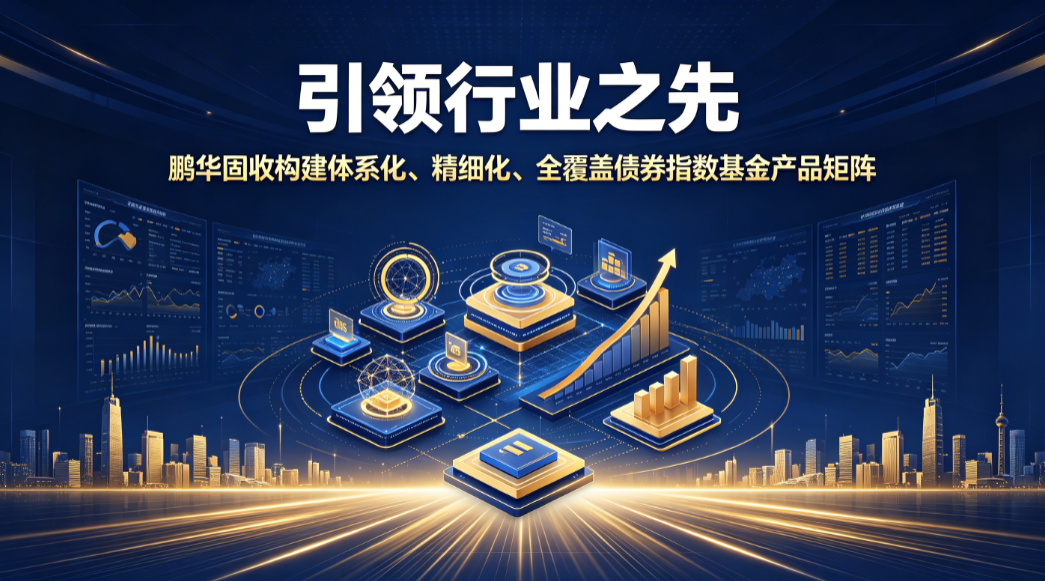
Within this fast-expanding market, Penghua Fund’s Cash Investment Department has spent years building a comprehensive “tool box” that spans four major categories: government bond indices, credit bond indices, certificate of deposit indices, and bond ETFs. The team has launched nine specialized products in total, covering ultra-short, short, and medium duration ranges. This increasingly complete product matrix not only reflects a forward-looking strategic layout, but also highlights Penghua’s ambition to become a true “bond index expert” in China’s fixed-income market.
The Rise of Bond Index Funds: From Optional Tool to Core Allocation
The logic behind the rise of bond index funds is straightforward: investors are no longer seeking only yield, but also clarity, efficiency, and resilience.
First, bond index funds provide a transparent and scalable foundation for asset allocation. Their underlying assets are identifiable, rules are clear, and liquidity is relatively strong, making them suitable as core building blocks in long-term portfolios.
Second, they help optimize portfolio risk-return characteristics. Because fixed income has relatively low correlation with equities, bond index funds can reduce overall volatility and improve the stability of portfolio performance, especially in turbulent markets.
Third, they serve an important role in cash management and transitional allocation. For funds waiting for investment opportunities or capital requiring temporary parking, short-duration credit bond index funds and similar products can offer a balance of safety, liquidity, and income.
This shift from a “selective” tool to a “standard” allocation asset marks the structural transformation of bond index investing. It is also why the segment has become one of the most important battlegrounds in China’s fixed-income market.
Penghua’s Strategic Answer: A Full Matrix Built Around Real Investor Needs
Penghua Fund recognized this trend early. As early as 2018, the firm made “fixed-income tool products” a core long-term strategic direction and entrusted its Cash Investment Department with the systematic development of its passive fixed-income product line.
The team’s product design follows two guiding principles. The first is to start from real client needs rather than scale expansion alone. In other words, each product is designed to address a concrete pain point in allocation, cash management, or duration management. The second is to support product innovation with forward-looking macro research. By closely tracking economic cycles, monetary policy shifts, and industry trends, the team has built a tiered framework that covers multiple duration segments, major bond asset classes, and both on-exchange and off-exchange channels.
As a result, Penghua now has a well-structured fixed-income index ecosystem with deep coverage across different investor types, risk appetites, and investment horizons.
Four Core Tool Categories, Nine Products, and Multi-Scenario Coverage
Penghua’s bond index products now cover a broad set of use cases across institutions and retail investors.
For investors seeking a stable core holding with low volatility and steady coupon income, the Penghua CSI 0-3 Year AA+ Preferred Credit Bond Index Fund provides a reliable “portfolio anchor.” For those who prioritize extreme liquidity and capital preservation, the Penghua Interbank Deposit Certificate Index 7-Day Holding product offers a short-term solution that combines ease of access with disciplined volatility control.
For professional capital with clearly defined duration strategies, Penghua’s 5-Year Local Government Bond ETF and 0-4 Year Local Government Bond ETF deliver precise duration matching and efficient exposure. For thematic capital seeking to participate in innovation-driven industries, the Science and Technology Innovation Bond ETF provides a low-cost, transparent, and efficient way to allocate to sci-tech credit.
This product structure is valuable not merely because it is broad, but because it is systematic. Different maturities, different bond types, and different trading venues together create a complete allocation framework that can serve a wide range of investors in different market environments.
Innovation First: Creating Industry-First Benchmark Products
Penghua’s competitive advantage is not limited to breadth; it also lies in innovation.
From 2019 to 2025, the team launched a series of milestone products, including the industry’s first 5-year local government bond ETF, the first 0-4 year local government bond ETF, one of the first certificate of deposit index funds, and one of the first science and technology innovation bond ETFs. These pioneering products filled market gaps in segmented categories and significantly enriched the fixed-income investor toolbox.
In a market where product homogeneity is becoming increasingly common, innovation is more than a growth strategy; it is a source of structural differentiation. Penghua’s early entry into niche bond ETF categories has allowed it to build first-mover advantages, deepen client recognition, and strengthen its reputation as a leader in bond index innovation.
Performance and Profitability: The True Test of Professionalism
In fixed income, product design matters, but long-term execution matters more.
Over the past several years, despite repeated market fluctuations, Penghua’s bond index funds have maintained relatively stable net asset value growth and demonstrated solid long-term performance. For example, the Penghua 5-Year Local Government Bond ETF and Penghua CSI 3-5 Year Policy Bank Bond Fund have both delivered competitive three-year returns, underscoring the value of high-quality index tools in medium- to long-term allocation.
Performance has also translated into tangible profitability for investors. By the end of the first quarter of 2026, Penghua’s fixed-income team, including money market products, had generated a cumulative RMB 3.44 billion in profits for investors, of which bond index funds contributed RMB 454 million. Notably, the Science and Technology Innovation Bond ETF delivered RMB 137 million in single-quarter profit, making it the top profit contributor among individual products in that period. This result highlights the allocation value of innovative thematic bond tools, especially in volatile markets.
A Strong Research Platform Supports Large-Scale Operations
Behind every successful fixed-income index product is a disciplined and highly specialized investment-research system.
Penghua’s Cash Investment Department is led by veteran managers Ye Chaoming and Zhang Jialei, both of whom have more than 15 years of industry experience and have navigated multiple market cycles. The team applies a clear division of labor across interest-rate, credit, and money-market research, while integrating investment, research, and trading into a highly coordinated operating model.
For credit bond index products, the team has built a three-in-one capability set: a robust credit evaluation system supported by Penghua’s active fixed-income expertise, a mature trading framework designed to control transaction costs, and an intelligent index management system that monitors tracking error in real time and adjusts portfolio operations dynamically.
Equally important, the department has established an integrated research and risk-control architecture that combines macro judgment, credit screening, and liquidity management. Decision-making blends individual accountability with collective discussion, ensuring both execution efficiency and risk discipline. As the team has observed, active investing is an art of experience and reflection, while index investing is a science of standards and execution. Different as they are, both ultimately depend on professional depth.
Conclusion
Since taking an early position in fixed-income tool products in 2018, Penghua Fund has gradually built a comprehensive matrix spanning four major categories and nine core products, while also launching multiple industry-first innovations. In doing so, it has created a meaningful first-mover advantage in China’s passive bond market and established a strong brand moat.
Today, as bond index investing enters a period of high-quality growth, supported by policy tailwinds, increasing institutional participation, and rising investor recognition, Penghua is well positioned to further strengthen its role as a “bond index expert.” With continued focus on product innovation and disciplined research capability, the firm is likely to remain an important force in shaping the next stage of China’s fixed-income index landscape.